Common Storytelling Mistakes and How to Avoid Them

The Dirty TruthThe great joy of being a first-time storyteller is that your entire life is new stage material. Everyone has those three or five great stories that they’ve been dishing from bar stools and dinner tables for years and years, so it’s natural to GO THERE when you decide to get your feet wet on the story stage. (Experienced storytellers, by the way, secretly despise newcomers for this mother lode of golden content, which the vets mined out of existence eons ago. Now they’re left stretching anecdotes from their kids’ bake sale or signing up for Tough Mudder races, hoping to turn pyrite into narrative pay dirt. It can get desperate out there in Storyville, so be warned…)

In a sense, the first-timer’s got it easy, with stories galore aligned with multiple themes for productions on every side of the Potomac. So pitch away, get cast, bask in the warm chatter of human communion! But beware – thar be trouble in the wine-dark river, for your story treasure may in fact be too rich! Our oldest, go-to stories can, over time, become over-larded with plot points and tangental asides and overwrought emotions that can ruin a tale for an audience that doesn’t know you personally.

Here are a few mistakes you can make when choosing your stories and translating them for performance. Remember: while your goal is being true to yourself and your story, you also have an obligation to those folks in the crowd. They want to know only what’s absolutely necessary to understand your story and why you’re telling it. Anything extra is stuff for another story, another time, and another slice of your personal truth.

Mistake 1: Storytelling – The Low-Cost Therapy Option.

What it is: You, sir. The one with the crossbow… Can you put that down? I know your partner left you after an unending engagement and you’re not feeling so hot right now. And that your devoted spaniel Tucker was recently run down… by a Tucker automobile at the Fairfax Classic Auto Show. (LOL! How ironic! SIR – the crossbow!) What terrible tragedies, truly. And… NO WAY! What kind of universe blights your heirloom azaleas at the same time? Perhaps the best choice for you then, instead of human massacre by medieval implement or professional counsel, is to see how many buckets of tears you can fill over eight minutes onstage. Let it out, man. All of it. Right now.

How it unhinges stories: The traditional story arc goes something like this…

  1. I’m this way (insert vulnerabilities) and…
  2. My whole life I’ve behaved in manner X, Y, & Z (as these cute micro-anecdotes reveal).
  3. Then one day, this nutty thing happened (insert thing) and…
  4. I heightened those behaviors I always do… or did something completely (and unexpectedly) different in response.
  5. As a result, I changed – usually for the better.
  6. Then the audience says, “Wow, this guy had a helluva (hard/good) time and has really processed that experience. It reminds of me of my (insert calamity/fortune). Maybe we can be social media contacts.”

But Therapy… teller hasn’t made it past step 3). That nutty thing? It’s not a singular event, confined to space and time, but this slow-motion, perpetual presence that continues to assault his identity. No detail about that moment is too insignificant to rehash, no vulnerability too trivial to reveal. The result is an avalanche of unexamined truth that leaves the audience with its fingers poised to dial 911.

Prophylactics: Make sure enough time has passed between your trauma and the time you decide to get onstage. You must have accepted the event and moved on. Carefully select the details about the event to include – you don’t have to tell us everything to be honest. Just focus on the most important, lingering elements, and only those that justify how it changed you. The rest can stay private and hopefully you’ll hold it together under the spotlight.
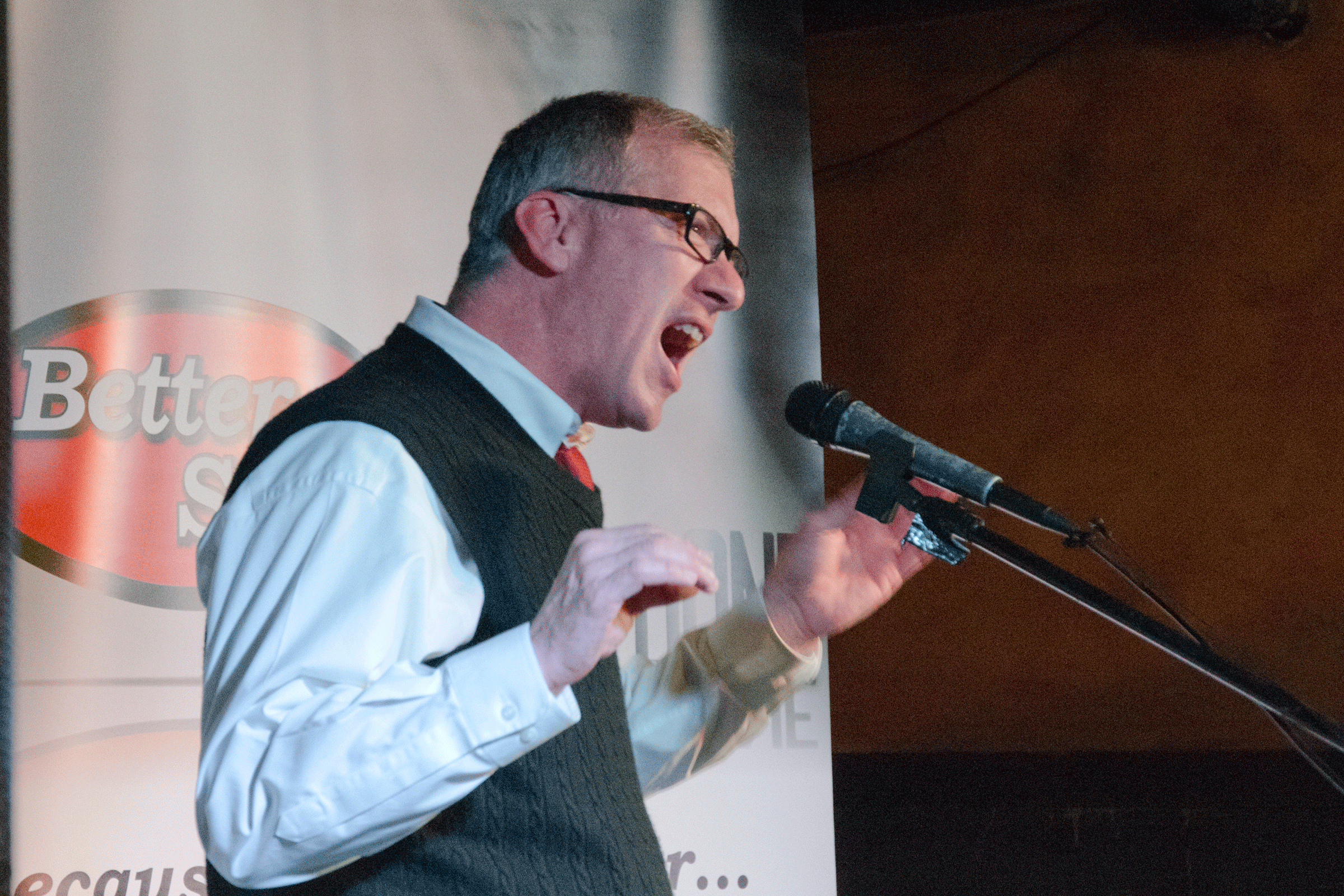
Storyteller

Mistake 2: Guys, this happened… to me!

What it is: Callow storytellers, this one’s for you. Maybe you were fired once for a bogus reason. Or maybe you were robbed at knife-point just a block from the local Whole Foods. Or perhaps you had a “cancer” scare when you confused a deep-tissue bruise for a “lump” and then spent a terrifying night in a Google hell-scape. I THOUGHT I WAS GOING TO DIE! But luckily, hours later, Dr. Nether-region set you straight. Phew!

How it unhinges stories: These stories masquerade as coming-of-age tales: I thought X was true, then found out it was really Y. Very relatable stuff – usually – but the Guys… teller focuses on the wrong details and trades his vulnerability for narrative minutiae. He gives us plot, not feeling or personal insight, and leaves the audience to sort out his hopes and fears as he repeats some version of “Crazy, huh?” over and over again. The effect is not only alienating but also fails to explain why a particular tale is worth recounting.

Prophylactics: Soul-searching, younglings! (Kidding, that’s for when you’re old.) Pare back the narrative to it’s most essential parts and spend more time there. The biggest moments should be slow, glorious languors. Choose key details that reveal your unique life-force, views, and passions. Trust the audience to fill in minor plot points (e.g., everyone knows that to enter a building, you have to go through a door).

Mistake 3: Scenes on a Theme – The Anecdotal Litany.

What it is: I’m so happy to be here tonight, I have so much to tell you about my lifetime of “Close Calls!” Like when I was 12, I was running late to school and ran my hardest toward the bus, but it pulled off before I got to my stop. I was feeling all glum – now I would have to ask Dad to drive me! – when BOOM the bus hit a cement truck! Soooo glad I wasn’t on there… Oh, and then, in college, I passed out in the middle of a keg stand and had to go to the hospital. I heard someone say, “Get her affairs in order,” but once I got my stomach pumped I felt better! Yay! And just a few weeks ago my child got lost at Target and I was convinced some bogeyman had taken him away. But then the store manager announced a Minecraft tournament in Electronics and he reappeared! I guess when it comes to close calls, I’m a lucky girl.

How it unhinges stories: This is a non-story shoe-horned into a production’s theme. The teller thinks it’s bonkers how Calamity Alpha is always happening to her, but she never connects this series of events to her life’s narrative and, perhaps worse, those events never really seem to change her. Listening to these stories is like hearing a bunch of bros trying to one-up each other with ever-more-esoteric Simpsons trivia at the bar at 2:00 a.m. The audience winds up not caring about the thin narrative that remains because the Litany teller has given them no reason to care about her. Those chairs you hear shuffling? That’s people sneaking off to the bar.

Prophylactics: Check out the traditional story arc from Mistake 1. You can stuff parts of your litany into step 2), but these must be quick hits meant to establish how you typically react when Calamity Alpha rolls your way. But you shouldn’t spend too much time there. Try to figure out what it is about you that explains why you are continually in the wrong place at the wrong time. And be sure to hold back one example of Calamity Alpha from your litany – this is where you’re going to highlight the one time that that event really changed you in steps 3) – 5). Slow things down, there, and show how the event hooked into your worldview and personal truths. This will explain why your litany matters to you and, not incidentally, the rest of us.


The Dirty Truth is a monthly column dedicated to the concept of truth in storytelling, written by Derek Hills and Kathy Baird.

Storyteller Derek HillsDEREK HILLS is a storyteller from Washington, DC and performs regularly with local heavyweights SpeakeasyDC, Story League, & Better Said Than Done. His first solo show – No Sex, Please – debuted recently at the Capital Fringe Festival. He’s now working on a new one-act comedy called Prison Break, which satirizes America’s extreme sports culture and will premiere in Fall 2015.
http://derekhills.com

Posted in Storytellers, Storytelling | Tagged , | Leave a comment

Standup vs. Storytelling: Part Three | Audience

Standup-StorytellingI once read about an experiment (somebody else read about it and told me about it) where five gorillas were placed in a metal cage with a cement platform in the middle of it. Above the platform were bananas. Any time one gorilla climbed the platform to get the bananas, the others were administered an electric shock. Soon, anytime a gorilla would head toward the platform to get a banana, the other gorillas would swoop in and give the offending gorilla a Cesar-style beatdown. The electricity had been turned off for days (nice little twist, eh?) yet, they still beat up any ape who tried to take the forbidden fruit.

I know what you’re thinking. Why didn’t I stop reading this yet? The point of that torturous psychological ape analogy is that nobody tells the people at these storytelling venues not to heckle or run around during the performances. It’s something that all new people just pick up on from those that have been there before. And yes, it’s because Jessica beat the crap out of a few indignant audience members in the early years.

Despite a large crossover in clientele, there are many differences in the audiences of standup comedy and storytelling. I’ll first tell you what they are and then hopefully run out of time before telling you why they are, because all I’ve come up with is the ape analogy smokescreen I deployed hoping you would just barely not understand it enough to make it sound like I knew what I was talking about.

First of all, there is no heckling in storytelling. There really shouldn’t be in standup comedy on the equivalent amateur level, but there is. And by heckling, I don’t necessarily mean the “You suck!” type of heckling that most people consider. There are many different ways to heckle.

The most obvious way to heckle is an attempt to degrade the performer. His or her joke, name, brand of cargo shorts, whatever. A lot of standup audiences believe that they have the right to be heard if they think they are funnier than the performer. Why? Because of the apes. That, and because standup is more confrontational, whereas storytelling is more emotionally vulnerable. Standup almost pits the performer against the audience in a form of battle whereas storytelling is an emotional journey the performer brings the audience on. Generally. And for those outlying performances that go the other way for either genre? Well, the bananas have already been sitting there for a couple days. No sense in pissing off the other apes.

The other, more subtle ways to heckle are when the audience doesn’t even know they’re heckling. I was trying to deliver a standup routine to someone who kept tagging all my jokes. “Sounds like my sister!” he said loudly and in an Irish enough accent for me to not completely understand him. I continued. He continued. “A mighty fine slut she was, no?” Yes he was drunk, but he genuinely thought he was helping my routine.

He was not. Don’t do this. Nor should you yell out “That’s so funny!” after every joke either. That doesn’t help as much as you think it does. Just go back home, find an email, hit reply all and type “LOL.” You should get your fix that way.

Slightly less abrasive but no less annoying are the indignant listeners who think they can just power talk through a performer’s set. I get it. We’re at a bar. You probably didn’t even know there was going to be a bunch of people talking into a microphone, ruining your chances of hooking up with some random sorority girl. But now that we’re here, how about you either find another forum for your drunken flailing attempts at catching strange or you at least try to be quieter than the guy with the microphone attached to an amplifier? Stupid apes.

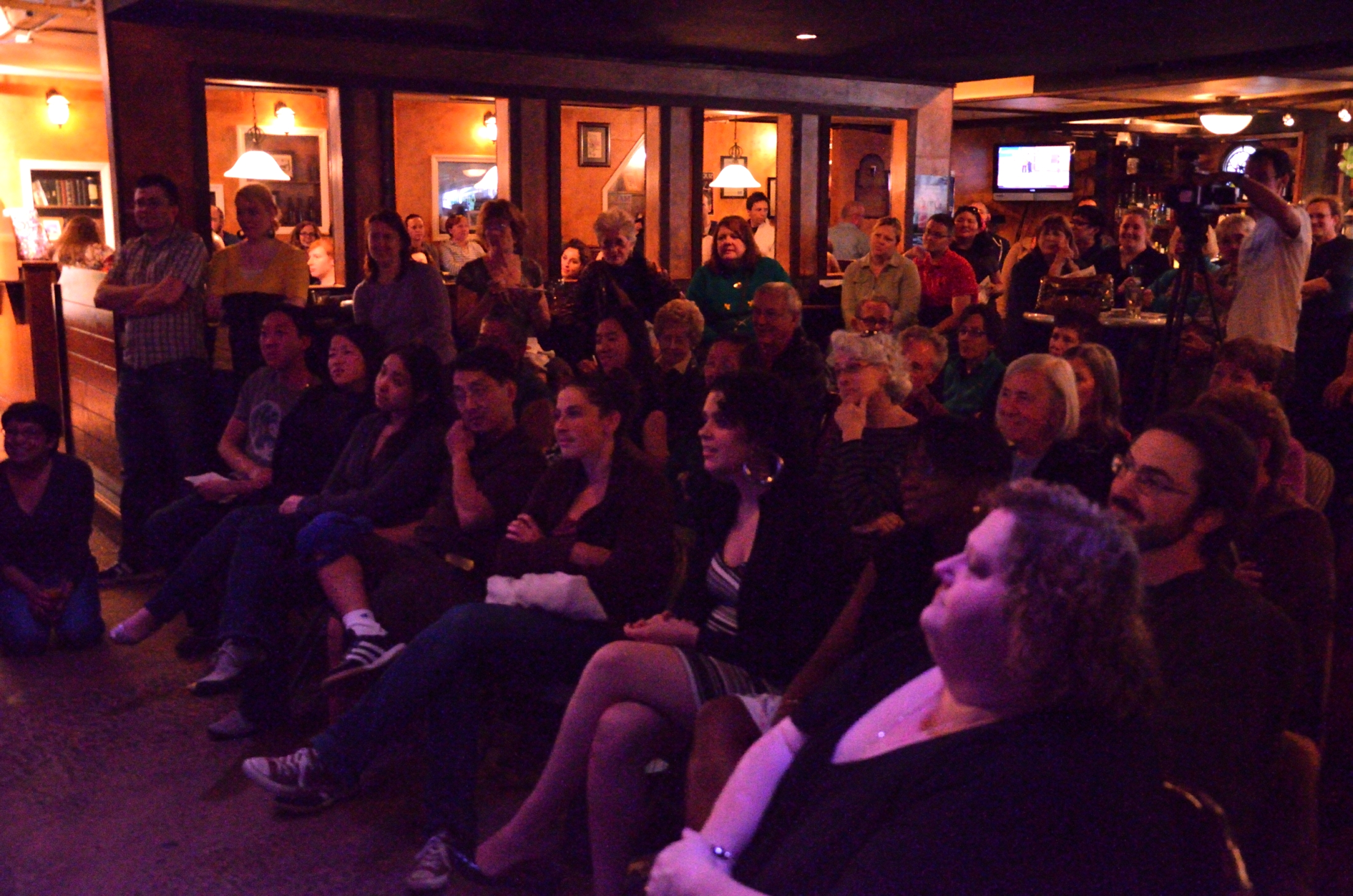
At every storytelling event I’ve ever attended (over 50), the audience members are ALL completely attentive, not talking (or the bare minimum at acceptable enough times), paying attention and remain seated for at least the entire length of each story. Sure, people get up between performances and take their smoke breaks, but people know not to interrupt a story. And when somebody does try to get back to their seat during a performance, they do that squat-walking, shoulder-tensed dance as if to say “Yeah, I know. I’m sorry.”

Maybe the subject matter commands a different atmosphere. Or maybe it’s the professional setting. But there are a lot of the same people in each crowd and it can’t be blamed on alcohol, which The Auld Shebeen also has in abundance. Maybe it’s the Better Said Than Done storytelling magic.

Or maybe it’s just the apes.

Dustin FisherDustin Fisher is an amateur stand-up comedian, award-winning storyteller, freelance writer and stay-at-home dad, all of which are just nicer ways of saying “unemployed.” You can follow along with him, his daughter Mabel, and his newborn son Morris as they learn how to raise each other at http://daddyneedsanap.com/.

His first memoir, Daddy Issues, is available in paperback, eBook, and Audiobook. Dustin has been published in the Huffington Post, The Good Men Project, Speakeasy DC blog, Baltimore Fishbowl, So Much Sports, Welter, Plorkology, and Baltimore STYLE Magazine. A list of his upcoming shows as well as a video archive can be found at http://dustinrecsports.com/.

Dustin lives in New Carrollton, MD with his wife Jennifer, daughter Mabel, son Morris, and one too many cats.

Posted in Storytellers | Tagged , , , | Leave a comment

The Tax Man Cometh

Better Said Than Done's Death and TaxesWhether you filed your 1040 months ago or have spent all day going through receipts, scribbling down numbers, searching for the post office with the latest possible drop-off, and downloading Form 4868 (automatic extension), we all know there’s a deadline at 11:59 PM.  There’s no escaping taxes.  In fact, only one other thing is certain …

Death and Taxes: stories about the unavoidable

Saturday, April 25, 2015
7:00 PM (Doors open at 6:00 PM)
The Auld Shebeen – downstairs
3971 Chain Bridge Road, Fairfax, Virginia 22030
$10 per person (Buy your tickets now or at the door.)

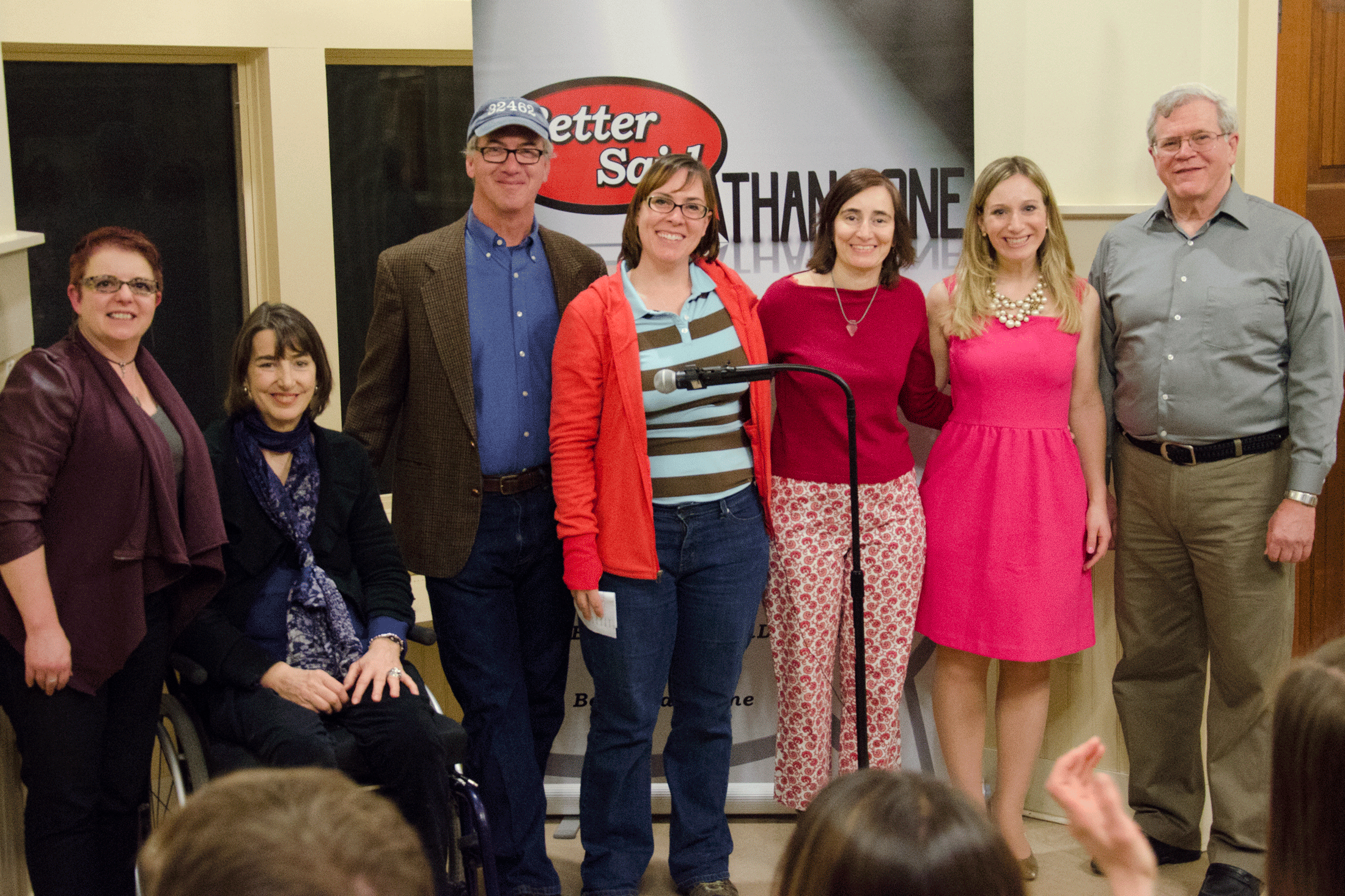
Listen to the true, personal stories about the unavoidable things in life from first-time teller Catherine Calvin, host Jessica Piscitelli Robinson, and return storytellers Richard Barr, Brent Heard, Miriam Nadel, Mel Pine, Cathy Smith, and Michael Zhuang.

Full menu is available.  Seating is first come, first served.

Do you want to get on stage? Check out our workshops to learn how to tell your story, or contact us to sign up.

And save the date for our upcoming shows!

The Mamas and the Papas: stories of moms, dads, and kids
May 30, 7:00 PM, The Auld Shebeen, 3971 Chain Bridge Road, Fairfax, Virginia (downstairs), $10 per person

I Coulda Died: stories about precarious situations
June 27, 7:00 PM, The Auld Shebeen, 3971 Chain Bridge Road, Fairfax, Virginia (downstairs), $10 per person

Screwed: stories of bad deals, naughty people, and getting screwed
July 25, 7:00 PM, The Auld Shebeen, 3971 Chain Bridge Road, Fairfax, Virginia (downstairs), $10 per person

Posted in Storytelling | Tagged , , , , , | Leave a comment

Finding Your Story

Storyteller Anna Marie TresterOne of my favorite things about teaching storytelling is helping people find their stories.  Often, I will hear from would-be storytellers “but I just don’t have any good ideas” or “I just have no idea what on earth I would talk about onstage.” Thus, addressing the question of “storyfinding” has become the first order of business at every workshop that I teach.

Having been a teacher now for more years than I care to count (and the daughter of teachers before then) I know that people have different learning styles, so I try to engage a few different kinds of ways of helping people find (remember) their stories. Here in this post I will describe a few of them.

If these sound like fun and like something you might want to try out– sign up for my workshop on the 18th and we can give them a go!  Have other ideas about good ways to find stories?  Bring them with you! I would love to hear them. 🙂

Continue reading

Posted in Storytellers, Storytelling Workshops | Tagged , , , , | 1 Comment

Video Extras with Alison (March 2015)

Video Extras with Better Said Than DoneJoining us for Video Extras, this month is first-time teller Alison, who stepped up to the mic after taking a storytelling workshop with Better Said Than Done.

Think of this as the commentary track to Alison’s story from our March 2015 show, Earth, Wind, and Fire: elemental stories. Watch her story below and then read on for the story behind the story. You can catch Alison in our May showThe Mamas and the Papas: stories of moms, dads, and kids, on May 30, at The Auld Shebeen in Fairfax. (Childcare will be available!)

[youtube http://www.youtube.com/watch?v=A7B1E_DHe3Y&w=560&h=315] Mary: Congratulations on an outstanding performance as a first-time teller! What motivated you to step on stage to tell a story?

Alison: Oh, thank you so much! Storytelling is something that I’ve been interested in for a while. A few years ago, I saw a Speakeasy DC show and loved it. It got me thinking about what “my” story would be if I were to tell one. This fall, I discovered Better Said Than Done, went to two shows, took a class, and finally got up my nerve to do it! I enjoy writing narratives and I teach high school, so, in some ways, I guess I “perform” a little every day; storytelling just seems like the perfect blend of the two.

Mary: What did you do to prepare to tell this story?

Alison: Taking the one-day workshop was instrumental in getting me from the “Someday I want to do this” mentality to the “Oh, I am actually signed up to tell a story” one. It was just really helpful to practice telling my story aloud and hearing honest (but supportive) feedback. Without that, it’s hard to get a good read on how well it may work.

In terms of preparing, I did write out my whole story, and I started to memorize it from that, but I noticed that it sounded like I was reading rather than talking. I ended up just using that as the jumping off point, practicing telling it in my own words so it sounded more natural. I also forced myself to record the story on my phone and then play it back. For me, hearing myself on tape is pretty excruciating, but it helped me a lot with making changes.

Mary: Did you have this story in mind when you signed up to take the workshop?

Alison: Initially, I had a hard time picking a story, but this trip is a memory that has always stuck with me, so I thought it might be a good choice. My friends in the area are very outdoorsy and athletic – I am not, obviously! I thought that telling this story would be a good way to kind of explain my perspective so they understood why I don’t jump up and down when someone suggests hiking/camping/roughing it.

Mary: Were there any details you had to cut – either for time or they just didn’t fit the narrative – that you’d like to share?

Alison: For the sake of time, I cut out some of the details about the breakup and my motivation for going on the trip. My boyfriend was a sophomore and I was a freshman, so when we started dating in the fall of my first year, I was just sort of absorbed into his already-established friend group and didn’t put too much effort into making my own. When we broke up, I realized I was losing most of my friends in addition to my boyfriend, so it was a big reason I accepted the invite to go camping. Carrie was pretty much my one close friend, and I thought maybe I’d meet other friends by going on the trip.

Mary: Your story is about what it takes to get over heartbreak. Can you tell me a little about your relationship?

Alison: We had dated for about seven months – early fall until April. Not a crazy long time, but long for an 18-year-old who’d never really had a boyfriend before. He was definitely my first love, which is a big part of the reason I think the break-up hurt so badly. I am pretty convinced that nothing ever feels as brutal as the shock of getting your heart broken for the first time. This camping trip came a week or two after the breakup, so I was still having a really hard time.

Mary: Did you know the other people on the camping trip besides Carrie?

Alison: It was more like I knew of them than I knew them personally. We hadn’t spent much time together up to that point since I lived on a different floor of the dorm and things tended to be a little cliquey depending on where people lived. Unfortunately, the trip wasn’t exactly the bonding experience I hoped it might be!

Mary: While you were alone in Al’s tent and getting rained on, you said that some of the songs that were playing in your head were, “All by Myself” – Celine Dion, “Nothing Compares 2 U” – Sinead O’Connor, and “Everybody Hurts” – R.E.M. Any other sad songs you’d recommend to someone who’s nursing a broken heart?

Alison: Ooh, great question.  Maybe “I Can’t Make You Love Me” – Bonnie Raitt – or “Almost Lover” – A Fine Frenzy.  Both are amazingly/terribly sad songs.  There’s a certain catharsis in just crying it out!

Mary: “I Can’t Make You Love Me” – that brings me back to some break-ups.  For me, that was up there with: “Separate Lives” – Phil Collins & Marilyn Matlin; “Throwing It All Away” – Genesis; “Anything For You” – Gloria Estefan & Miami Sound Machine; and “We Belong” – Pat Benatar.

Alison: And then there’s “I Will Survive” – Gloria Gaynor and “Ridin’ Solo” – Jason Derulo, for phase two, when you’re ready to feel better and hit the gym and realize life goes on.

Mary: Are spiders still your biggest phobia?

Alison: YES! I know it’s irrational, but I can’t help it.

Mary: Have you ever gone camping since the trip in this story?

Alison: I’ve stayed in some cabins, but no “camping” camping, much to my husband’s dismay. 🙂

Posted in Storytellers, Storytelling | Tagged , , , , , , | Leave a comment

Friends of Reston Storytelling Videos

Thank you to everyone who attended the storytelling benefit show at Walker Nature Education Center. Better Said Than Done storytellers, with your help, raised nearly $800 for the Friends of Reston for Community Projects. Also, a special thank you to the evening’s volunteers, which included most of the Friends of Reston Board. A personal thanks goes out to Kian McKellar. He came to watch a storytelling show and got suckered into performing his day job. Thanks for being awesome, Kian, and thanks for the awesome videos!
Better Said Than Done Storytellers

Here are some of the videos from Better Said Than Done’s most recent storytelling show “Earth, Wind and Fire.”

Host Jessica Robinson’s Earth story
.

First time storyteller Alison’s camping tale.
Continue reading

Posted in Storytellers, Storytelling | Tagged , , , , , , , | 2 Comments

Standup vs. Storytelling: Part Two | Content

Standup-StorytellingSome high school friends and I began writing a book back in the mid-90s about casual humor called “We’re So Serious about Comedy, It Isn’t Funny.” We’re still waiting to hear back from some publishers. We dissected all comedy into what we called The Four “C”s of Comedy. Those Four “C”s are Content, Context, Timing and Delivery.

Seriously, if any of you know of any desperate publishing houses, let me know.

When stripped of nuance, expectation and all other spices, the only difference between storytelling and standup is in the content. It’s the difference between getting a tub of Legos and being told to make a bird and being told to make anything. While those given the latter instructions could certainly make a bird, is that really the funniest thing you could make? Why not make a horny toad? Or a platypus? Or why make anything at all? Maybe you could just line up the Legos one after another. Or just pile them into a scrap heap. Or throw one up in the air and just when the audience is reaching out their arms to catch it, you violently sidearm another one into the audience’s jaw.

As for the other group, there are a lot of different kinds of birds. Exotic birds like macaws and cockatoos and flightless birds like penguins and velociraptors, depending on whether you believe Jurassic Park. But the audience will know if you try to give them a giraffe with wings. Or if you take off the beak and sidearm it at their jaw.

If you justifiably did not keep up with this analogy, the “bird” represents structure. Storytelling has an expectation of a story – beginning, middle, end. Standup does not confine its performers to this structure, but certainly doesn’t forbid it. However, because of the desire to get as many laughs as possible in the standard standup five minutes, one-liners and anecdotal humor are usually the weapons of choice. For reasons I will delve into deeper in my dissection of the difference in audience, longer stories with character growth, plot development and more than 20 seconds between laugh lines is a good formula for a collective audience smoke break in the five minute standup format.

The other difference in content, and arguably the more intriguing element, is the expectation of truth. This has been a hotly contested topic within the storytelling community, in memoir critiques and in one-man performances, a.k.a. Mike Daisey’s The Agony and Ecstasy of Steve Jobs. How much exaggeration is too much exaggeration differs from show to show, person to person and minute to minute and is a shark-infested ocean I will not be rafting into right now.

The difference is obvious in execution. All material told on a standup stage is meant to be taken with a grain of salt. Phrases like “No joke” and “I’m not kidding” and “This seriously just happened to me on the drive here” are more often than not followed with a story that didn’t happen on the drive there. In this way, the standup world is much easier to write for. I had a story I told on the standup stage but had no real end to it so I just made one up. It’s an acceptable liberty granted to standup performers in the name of maximum laughter. I went to tell that story on the Speakeasy stage and had to instead figure out how to make the real ending interesting through philosophical exposition or a cock of the eyebrow or some other random guess.

With storytelling, sometimes you have to dress up the bird in fancy clothes or a hat or have it give the middle finger to the crowd, but the expectation of truth is not something to squaw at. The audience is there to see the birds. Give them a bird.

A night of storytelling

Dustin FisherDustin Fisher is an amateur stand-up comedian, award-winning storyteller, freelance writer and stay-at-home dad, all of which are just nicer ways of saying “unemployed.” You can follow along with him, his daughter Mabel, and his newborn son Morris as they learn how to raise each other at http://daddyneedsanap.com/.

His first memoir, Daddy Issues, is available in paperback, eBook, and Audiobook. Dustin has been published in the Huffington Post, The Good Men Project, Speakeasy DC blog, Baltimore Fishbowl, So Much Sports, Welter, Plorkology, and Baltimore STYLE Magazine. A list of his upcoming shows as well as a video archive can be found at http://dustinrecsports.com/.

Dustin lives in New Carrollton, MD with his wife Jennifer, daughter Mabel, son Morris, and one too many cats.

Posted in Storytellers, Storytelling | Tagged , , , | Leave a comment

Storytelling in Reston’s Nature House

Better Said Than Done got it’s humble launch at the Walker Nature Education Center in Reston, VA back in 2010. Our first and second storytelling shows in Virginia were fundraisers for the Friends of Reston. We continue to honor that tradition by hosting one or two storytelling fundraisers a year at the Reston Nature House.

The most recent storytelling show was “Earth, Wind and Fire,” hosted by Better Said Than Done Founder and Friends of Reston Board President Jessica Robinson. The night of storytelling opened with Friends of Reston Executive Director Katie Shaw making a few statements about all the wonderful projects the Friends of Reston participate in before introducing Jessica.
Katie Shaw

As host, Jessica shared one Earth, one wind and one fire story throughout the night. Of course, there were a few other storytellers too. First time storyteller Alison joined Better Said Than Done after taking one of our storytelling workshops. Her perfectly manicure coiffure served as the perfect clue as to why she didn’t have the absolutely best time going camping.
storyteller

BN Heard came prepared for the show, to talk about being not quite so prepared for a hurricane.
storytelling

Mattie Cohan explained why snow makes her lose just a little faith in humanity.
storyteller

Another graduate of a Better Said Than Done workshop, and first time on our stage, Helen Qubain told about one adventure she had in the mountains of Tagikistan.
storytelling

Richard Barr told tales of a hurricane that hit during his days living on the Gulf Coast in Texas.
storyteller

The ever amazing Anne Thomas closed the night out with a dark tale of Sicilian terror.
storytelling
As always, it was a fantastic night of storytelling. Additionally, the show was sold out – almost completely in advance tickets – and Better Said Than Done raised nearly $800 for the Friends of Reston for Community Projects. That right there is the power of storytelling.
Better Said Than Done
The Better Said Than Done storytellers return to the Auld Shebeen, in Fairfax, VA, on April 25th for our next night of storytelling – “Death and Taxes.” Tickets available here.

Posted in Storytellers, Storytelling | Tagged , , , , , , , | Leave a comment

Stranger Nonfiction Storytelling

In Better Said Than Done’s February show, “Stranger Than Fiction,” at The Auld Shebeen in Fairfax, VA, the storytellers shared some truly unbelievable tales. We don’t always post all the videos of the true stories shared, but this time you get to see every one right here. Enjoy!
storytelling show

Richard Barr began the night of storytelling with a NY mystery.
Watch Storyteller Richard Barr Here.

Solveig Eggerz joined the Better Said Than Done stage for the first time with her story about two broken vases spanning a lifetime. Watch here.

Storyteller Mel Pine discovered the meaning of his life with this true story. View the story here.

As a Cavazos, Ann has driving in her genes. Find out what kind of driving here.
Continue reading

Posted in Storytellers, Storytelling | Tagged , , , , , | 1 Comment

Video Extras with Richard Barr (November 2014)

Video Extras with Better Said Than DoneIn this month’s Video Extras, we chat with storyteller Richard Barr. Richard first stepped on the Better Said Than Done stage as a first-time teller in September 2013 and has been back to share his stories many more times.

Richard is providing commentary on his story from our November 2014 show, Leftovers: stories about gluttony, forgotten things, and do overs. Watch his story below and then read on to learn more about the story behind the story. And don’t miss Richard in our next showEarth, Wind, and Fire: elemental stories, on March 21, at the Walker Nature Center in Reston.

[youtube http://www.youtube.com/watch?v=4F0rg8ZVTGU&w=560&h=315] Mary: Having told about a dozen stories on stage now, have you settled into a routine for how you develop a story that you will perform?

Richard: First, since the stories have to be personal and true, I have to find a memory that fits the topic. Fortunately, I’m old enough to have a good selection to choose from. With a core anecdote in hand, I then have to put it in context, so I start telling myself the story. And, once I know the story, I have to cut it down to a manageable size. For this story, I told it to myself over and over while driving, in the shower, and during every other free moment.

Mary: Did the story change much as you prepared?

Richard: The facts are what they are. I tinkered with how much description to use and of what. Most important then – and always – is the final sentence that somehow gives the story weight and importance.

I could have said more about my job and the psychology of weapons, but the thing I wanted most to say and didn’t was the reason for LeFrak’s decline.  But, I wasn’t a part of it, and didn’t want to turn my story into a rant.

Mary: Was it difficult to adjust to living in the Big Apple having grown up in Texas?

Richard: I was in Texas from ages 2 to 15, and in South Carolina from 15 to 20. But, I’ve always been adaptable. I was surprised to see how parochial New Yorkers were. Coming from small towns, I knew a wider world existed; New Yorkers didn’t.

Mary: Had you been to New York before you moved there?

Richard: A friend and I drove to the Montreal World’s Fair in ’67, stopping off in New York on the way up and the way back. It was a trip as wild and crazy as I get. Maybe I’ll tell that story sometime.

Mary: Why did you decide to join the LeFrak City police force while you were waiting for your civil service appointment?

Richard: I had been working as a store detective.  We had a director who wanted to fire the entire staff in order to bring in his own people.  When he fired a good friend of mine for a trumped up reason, I looked for another job and found LeFrak.

Mary: When the man interviewing you said, “I see you were raised in Texas, so you know how to handle yourself,” what did you think he meant and what would like to have replied – had it not been a job interview?

Richard: When I first arrived in New York, I was stereotyped because of my accent, so I was not surprised to hear a remark of that nature. In another context, I might have suggested that judging individuals based on stereotypes is a personal mistake and a professional danger.

Mary: Of all of the interesting jobs you have held, which have you enjoyed the most?

Richard: I loved being a Customs Inspector. Every day brought new puzzles to solve, adventures, fascinating people, and opportunities to learn, and pretty much everybody treated me with respect. Consulting seemed more like a scam than a service; it was even worse than selling used cars. I wouldn’t want to do either of those again.

Mary: You explain in your story that the first rule of policing is that when an officer is on the scene, the officer has to be in control. You said, “Getting control and keeping it is the art of the job.” Can you explain this idea of the “art of the job” more?

Richard: When I hear about some of these police shootings, they make me sick. An officer has to read each situation and the individuals involved. People who are confronted by the police are often frightened and will react in unexpected ways. You have to provide witnesses and perpetrators alike the chance to vent and explain. Tell them you understand and sympathize. Never shout. It is not an officer’s job to judge or punish. My attitude was always: I will make this experience as pleasant as you allow me to make it.

Mary: You removed your hat to create a less authoritative and threatening profile when you entered the apartment. Where did you learn this?

Richard: I read it in some reference material. It made sense to me, and was certainly worth a shot.

Mary: And this is how you closed your story:  “Sometimes, if you’re paying attention, all you have to do is take off your hat.”  Why do you think that’s so important?

Richard: The hat was a metaphor, but certainly when cops show up with helmets and body armor, it doesn’t send a positive message. Very few mentally ill people are violent. Very few sober people are violent. Treat individuals like individuals. Figure out who they are and what they need.

Mary: Do you think this interaction might have been different had you been armed?

Richard: I don’t think the woman noticed I was unarmed when I entered her apartment. I had the utility belt with handcuff case and nightstick. I would not have drawn my weapon on her. She was emotional, not a street fighter, and I believed that I could subdue her if necessary.

Mary: Did you find out later what the other officers thought when they came in and the woman was there partially undressed?

Richard: No, I trusted they figured out the truth for themselves.

Mary: Did you respond to other dangerous situations while on the LeFrak City police force?

Richard: A few, but they were more conventional. We had to keep neighborhood street gangs off the property. Outnumbered and unarmed, I bluffed through incidents like that. I saved a man from an apartment fire by climbing from one balcony to another on the 11th floor.

Mary: Was this job your last foray in law enforcement?

Richard: No. I wanted to work for Customs, but under the rules for civil service, I had to accept any job offered.  That’s how I spent 8 years with the Veterans Administration in Manhattan.  Then, Customs had a hiring mandate and I transferred over for the next 20 years. I worked for Customs in Newark with regular trips to Regional HQ in the World Trade Center, and occasionally to JFK. After 4 years as an inspector, I went to DC to work in the Office of International Affairs and traveled the world. Then, I spent a few more years as a Customs program manager in DC.

Posted in Storytellers, Storytelling | Tagged , , , , | Leave a comment